Active thermographic methods for drone-based monitoring of coating damage on industrial heritage sitesResearch project
Coating surfaces is one of the most common strategies for slowing down the destructive corrosion process on industrial heritage buildings. These coatings are subject to continuous degradation and must be renewed once they reach a certain condition in order to ensure intact protection against the progression of corrosion. In this project, the possible applications of active thermography for monitoring the condition of the aforementioned coatings will be tested using a number of typical fault patterns.
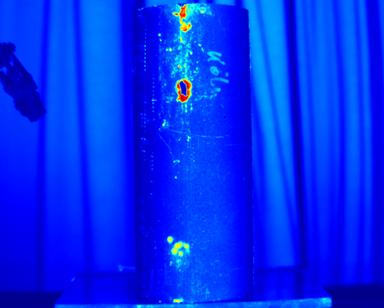
Active thermography offers a number of advantages in this context as a contactless and non-destructive method. The surface of the object is specifically stimulated by an external heat source. The resulting temperature distribution on the surface is recorded and analyzed using an infrared camera. Homogeneous and intact layers show uniform cooling, while defects such as under-rusting or layer detachment lead to thermal anomalies. This means that damage can potentially also be detected under visually intact coatings.
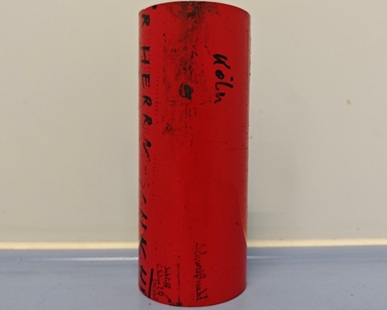
The size of the objects and surfaces makes it necessary to use highly mobile technology, such as drones, for practical and economical application. However, this technology places additional demands on the platform in terms of weight, stabilization, and efficiency of the measuring and excitation equipment, among other things. The selection of suitable excitation methods and parameters, as well as the adaptation of detection technology to the requirements of drone or UAV (unmanned aerial vehicle) operation, are therefore key aspects of the future methodology. To this end, typical defects that occur in historical industrial facilities (e.g., crack infiltration, blistering, or incomplete adhesion) will be simulated in laboratory tests in order to systematically evaluate the sensitivity and significance of the method.
The aim is to develop a robust thermographic testing method suitable for UAV use that is suitable for both preventive maintenance and condition assessment in monument preservation.
Project goals
- Early detection of corrosion and coating defects on objects of industrial heritage using active thermography
- Development of a practical methodology for mobile, non-contact monitoring of large objects using UAVs
- Comparison of established excitation sources in terms of suitability for UAV use with regard to efficiency, weight, and energy consumption aspects
- Optimization of thermographic excitation devices for drone application
- Damage detection of practical fault patterns using active thermographic methods
- Optimization of damage detection under the restrictions required for drone application
- Design and testing of a portable complete system consisting of an excitation unit and thermographic camera for UAVs, as well as testing under real operating conditions
- Validation of recognizable practical damage patterns using the aforementioned methodology
Contact
Prof. Dr. rer. nat. Michael Prange
- Michael.Prange@thga.de
- Telephone
- +49 234 968-3381
- Office
- G3 R102

Fabian Stöhr
- Fabian.Stoehr@thga.de
- Telephone
- +49 234 968-4049
- Office
- G5 R308a